Applies to: Uniclass work section-based specifications only.
Working with specification specialists at the practices AHMM and BDP, we have developed an alternative structure for the published output - see article A more concise output format for specifications.
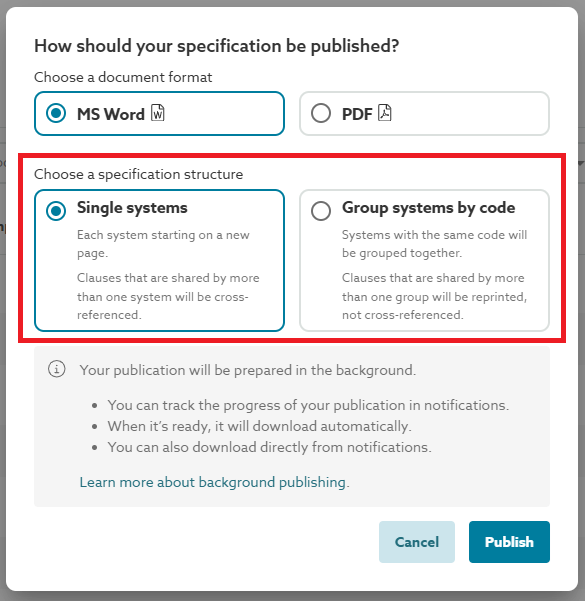
You can choose to structure the published specification by 'Single systems' or 'Group systems by code'. This article explains the difference between the two formats.
Video comparison between the two formats.
There are three differences between the two formats.
| Difference | Single systems | Group systems by code |
| 1. Table of Contents | - Each system is presented in the ToC in order of their code.
- Multiple types of the same system are presented by code order then alphanumerically by their prefix, then alphanumerically by their suffix.
- The ToC includes for each system clause the Code, Prefix, Title and Suffix details.
| - Each system is presented in order of their code.
- Multiple types of the same system are grouped under one heading.
- The system title of the first system in the sequence is presented in the ToC.
- This means there is only 1 entry in the ToC for each group of systems.
- The Toc includes for each group of systems the Code and Title.
|
| 2. The layout of the specification body | - Each system is presented separately.
- The System outline will be presented, then the linked performance, product, execution, system completion and system facilities management clauses will follow next.
- If there are multiple types of the same system they will follow one after another.
| - Each system with the same code is grouped.
- When there are multiple types of the same system, the system outlines are presented one after another.
- All of the linked clauses are grouped. So all of the performance clauses are presented together for the whole group of systems. Followed by all product clauses, execution, system completion and system facilities management clauses.
- The system outline indicates what clauses relate to it.
|
| 3. Shared clauses | - Shared clauses referenced across the document are only published in full the first time they appear in the specification.
- To indicate they are shared across the specification they will have a 'shared by' reference.
| - When a clause is linked to by more than one group of systems, the shared clause is presented in full in each group.
- Because shared clauses are published in full in each group there is no 'shared by' reference. Groups can be read standalone and contain all of the clauses they reference and are presented fully.
|
| Summary | - This document format is most similar to the format published by NBS Create.
| - This format produces documents of the shortest length.
- This format was developed with input from AHMM and BDP in the UK.
|
